Editor’s note: This is a guest essay by Mr. Đinh Hồng Dương, who has lived and worked in Lai Châu for nearly thirty years. On an independent trek up Putaleng (3,049m), Vietnam’s third-highest peak, he set out to understand the young Dao men who guide travellers through the mountain’s thousand-year rhododendron forest — and the quiet way they keep it alive. We have translated his piece closely from the Vietnamese, the journey and the words are his. A few Vietnamese terms are glossed in brackets.
Stepping into the Memory of the Ancient Wilderness
More than two years have passed since that Putaleng trek, yet whenever I look back, those gnarled, ancient rhododendrons rising from a sea of clouds still appear in my mind. In September, as the late-summer rains eased across the Hoàng Liên Sơn range, four friends from Hanoi and I set out to conquer the majestic peak of Putaleng — Vietnam’s third-highest mountain and the pride of the Northwest. For many, Putaleng is merely a destination for restless feet. But for me, after nearly thirty years of living and working in this borderland region, the journey held a different meaning. I wanted to delve deeper into the pristine old-growth forests, to see Putaleng’s ancient rhododendron groves with my own eyes, and above all, to understand the people who live with the forest, protect it, and draw a livelihood from it in their own unique way. After many delays due to work and weather, the journey was finally happening.
Currently, there are several routes up Putaleng. We decided to begin our ascent from Xin Chải village in Giang Ma and descend the mountain via Tả Lèng. Our lead guide was Phàn Ngọc Tải, a young Dao man and a respected figure in his village.
I first met Tải over the phone through an introduction by a friend in the commune police. His voice was earnest, articulate, and carried a deep sense of responsibility. Before our departure, he asked the entire group to send our ID details to register with the local authorities [standard practice for treks in this border region].
“The government supports adventure tourism, but we have to report to the commune police so they are informed, brother,” he explained. “If anything happens, they can support us in time.”
It was a simple statement, but it made me acutely aware of the shifting approach to community-based tourism in the highlands.
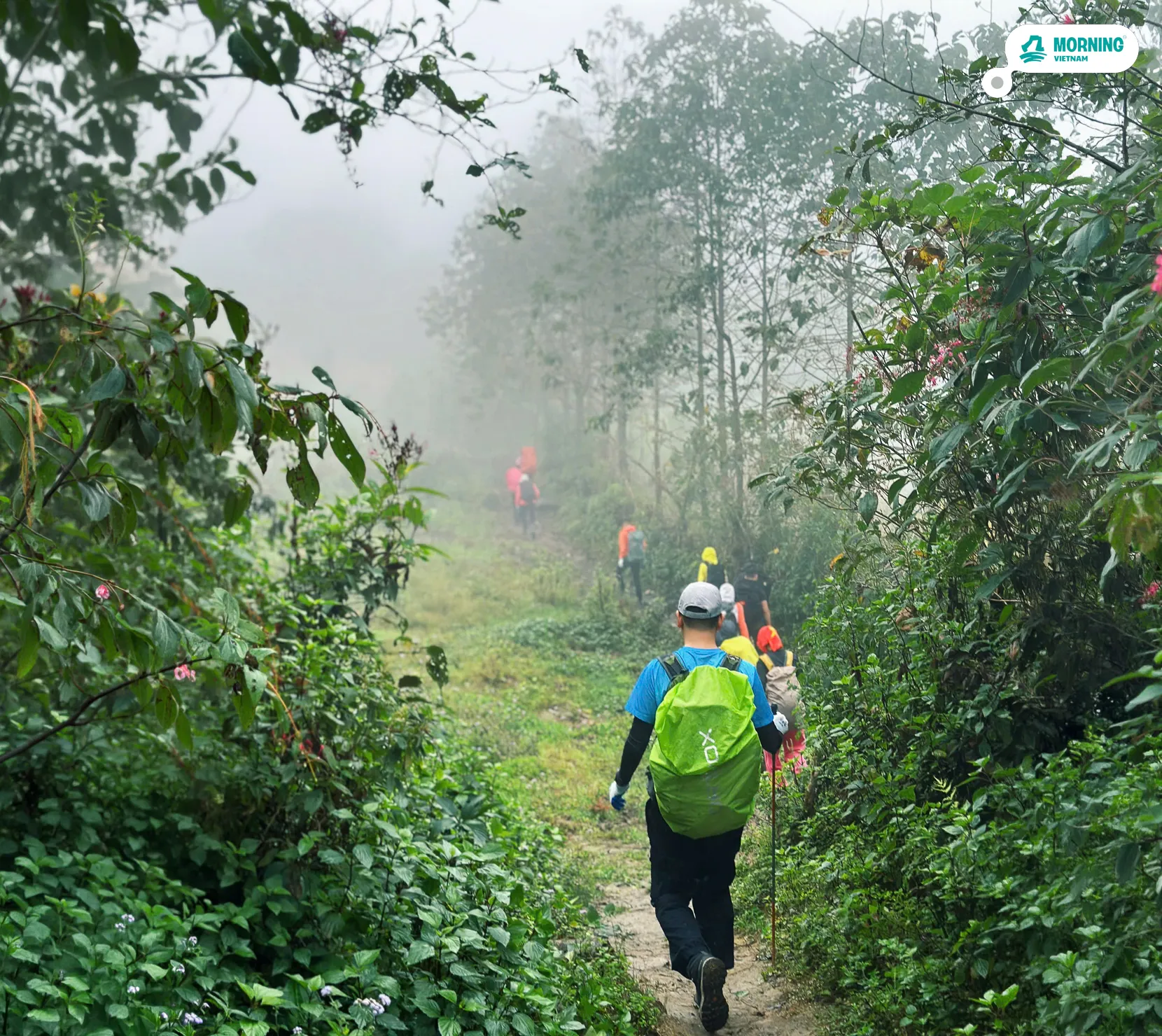
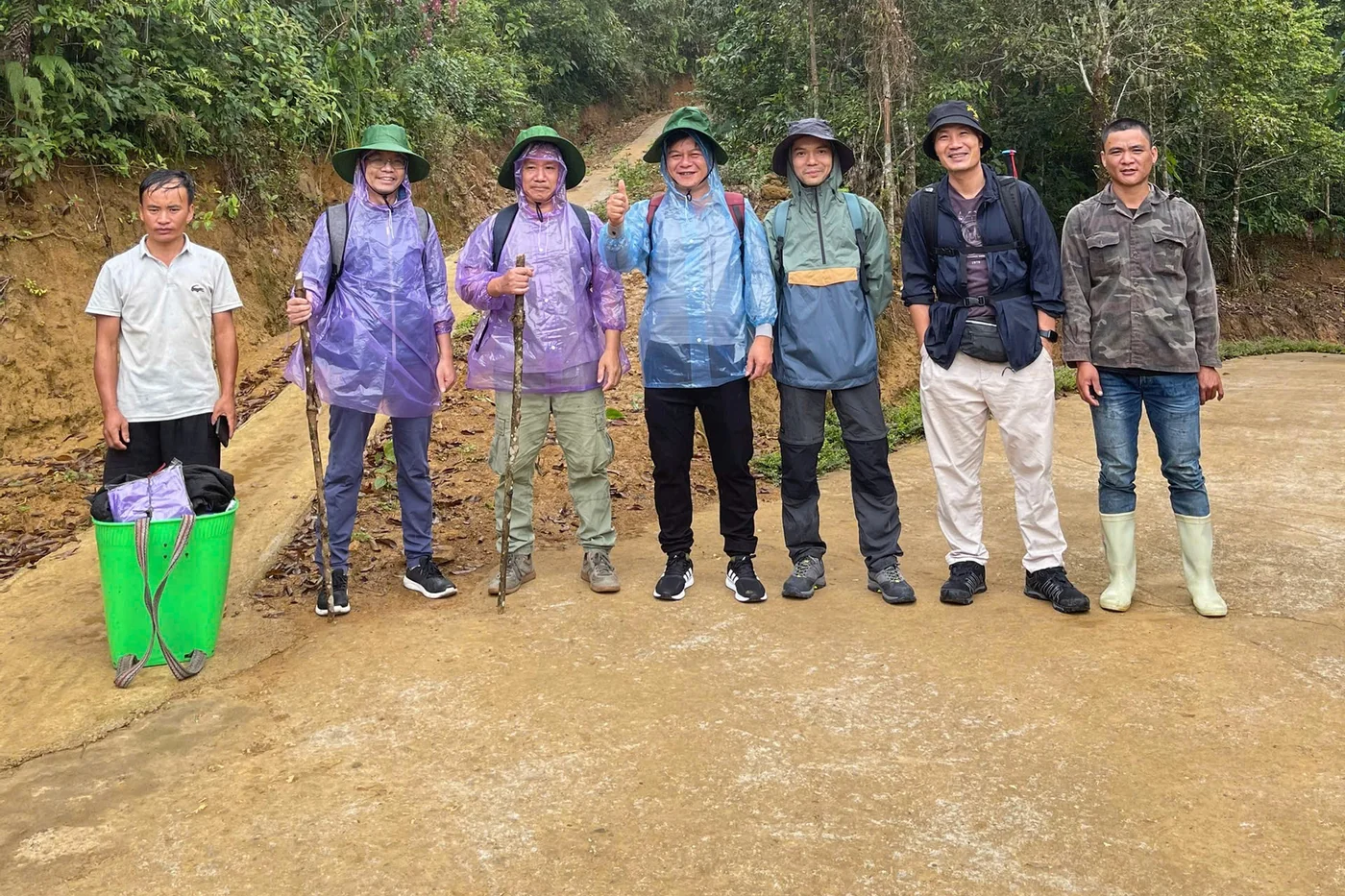
Early that morning, starting from the edge of Xin Chải village, our group of five guests and three porters — Phàn Ngọc Tải, Hoàng A Tải, and Châu A Goong — began our ascent. Before setting off, Ngọc Tải briefed us on safety rules with a smile:
“I’ll lead the way, you guys walk in the middle, Goong will bring up the rear, and A Tải will go ahead to set up camp and handle logistics. Take your time so you don’t exhaust yourselves. If you want to take photos, just stop. I also have all the first-aid gear right here.”
He patted the rescue bag strapped to his hip, stocked with medicine, bandages, and essentials for the trek. That attentiveness put us at ease from our very first steps.
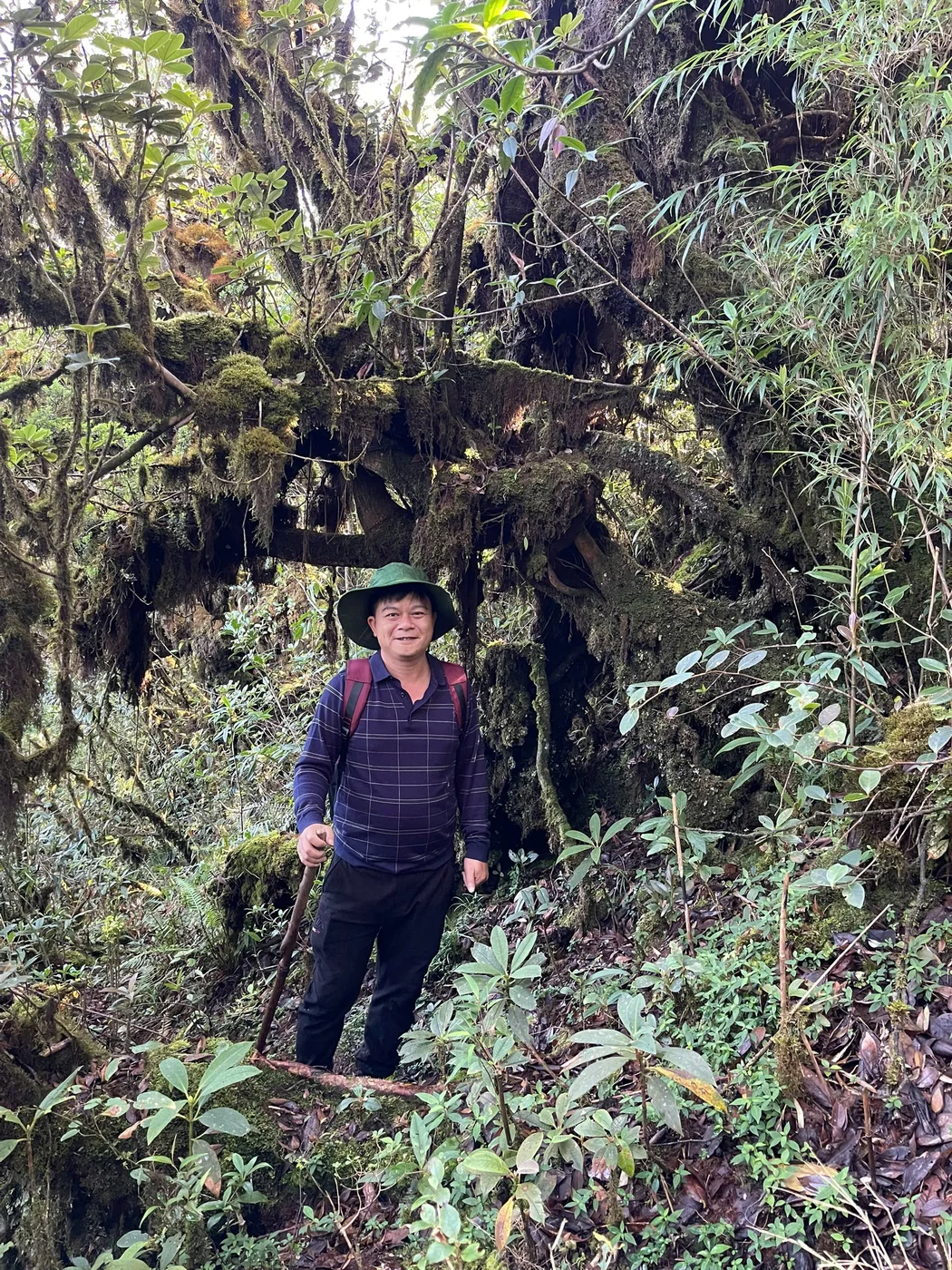
A light autumn drizzle drifted through the crisp air at an elevation of over 1,300 meters. The trail quickly slipped beneath the canopy of the primary forest. Ancient trees blanketed in lichen stood in solemn silence, their vines cascading from aged branches to weave ethereal, natural curtains. The higher we climbed, the more the forest assumed the brooding mystery of a primordial world. Ancient Shan Tuyết tea trees [high-mountain snow tea] wore coats of green moss, while giant ferns towered overhead. Beneath our boots, a thick, spongy layer of decaying leaves, accumulated over countless autumns, made each step feel like sinking softly into the memory of the ancient wilderness. In that surreal space, the distant sounds of wind, rushing water, and birdsong gave me the sense that I was walking through a forest that had existed long before the first villages ever appeared at the foot of Putaleng.
Near noon, as we passed a cardamom patch clinging to a cliffside, Ngọc Tải pointed down at the wooded slope below. “A troop of long-tailed macaques often comes foraging down there.”
“Are they hunted?” I asked.
Tải answered without hesitation. “Our village held a meeting and agreed to protect them; it’s written into our customary laws. Anyone bringing traps or flintlocks into the forest will be monitored and reported to the commune police.”
In that moment, a realization struck me. The people helping to preserve the green canopy of Putaleng were not just the forest rangers. They were also guides like Ngọc Tải, A Goong, and A Tải. They knew every tree stump, every monkey troop, every headwater stream. They made their living from the forest not by extracting what nature offered, but by guiding travelers in to experience its beauty. Perhaps this was the truest path to conservation: letting the forest sustain the people, so the people, in turn, would protect the forest.
I had met many people who spoke about nature conservation at conferences and forums. Yet on Putaleng that day, the lesson in conservation came from young Dao men with sunbaked faces and mud-caked boots. Perhaps the preservation of these forests does not begin with slogans. It begins with the simple love of those who call the forest home.
Amidst the old-growth woods of Putaleng, I began to understand that this journey was not just a story about a mountain peak. It was a story about the people living beneath the ancient rhododendrons.
The Guides of the Ancient Wilderness
People often remember Putaleng for its elevation of over 3,000 meters, its mysterious old-growth forests, or its famous sea of rhododendrons that blooms every spring. But for me, long after the trek, what lingered most were the people: Ngọc Tải, A Tải, and A Goong — three young Dao men born at the foot of the mountain. They earned their livelihood from the forest while helping to preserve the green of the ancient wilderness.
Of the three, Ngọc Tải made the first impression on me. It wasn’t just his diligence and responsibility, but the way he spoke of the mountains. Whenever we passed a massive ancient tree or a beautiful patch of woods, Tải introduced it as if he were showing guests around his own home. At the mountain ridge where the long-tailed macaques often foraged, he pointed down the slope and said:
“I plan to plant more bananas around here early next spring so they have food. Trekkers love it when they can spot monkeys in the wild.”
His remark took me by surprise. Behind that simple thought was a profound understanding of nature conservation. A forest is only truly alive if birdsong still rings out each morning and animal tracks still mark the trails. To many, a forest is a resource to be extracted; but to Tải, the forest is the future. A beautiful forest attracts visitors. Visitors bring income to the village, leading to a better life. It is a simple yet entirely sustainable cycle.
Watching Ngọc Tải walk through the ancient woods, I realized he was like a living guide to Putaleng. He knew which season the rhododendrons bloomed most brilliantly, where the macaques foraged, and where bear tracks had once appeared. That kind of knowledge cannot be found in books; it was cultivated through a childhood spent growing up with the mountain forest. It is people like Tải who are preserving the vast, invaluable traditional ecological knowledge of this land. These are insights earned through countless seasons in the wild, days lived alongside the mountain, and years maturing beneath the ancient canopy — a repository of knowledge no text could ever fully capture.
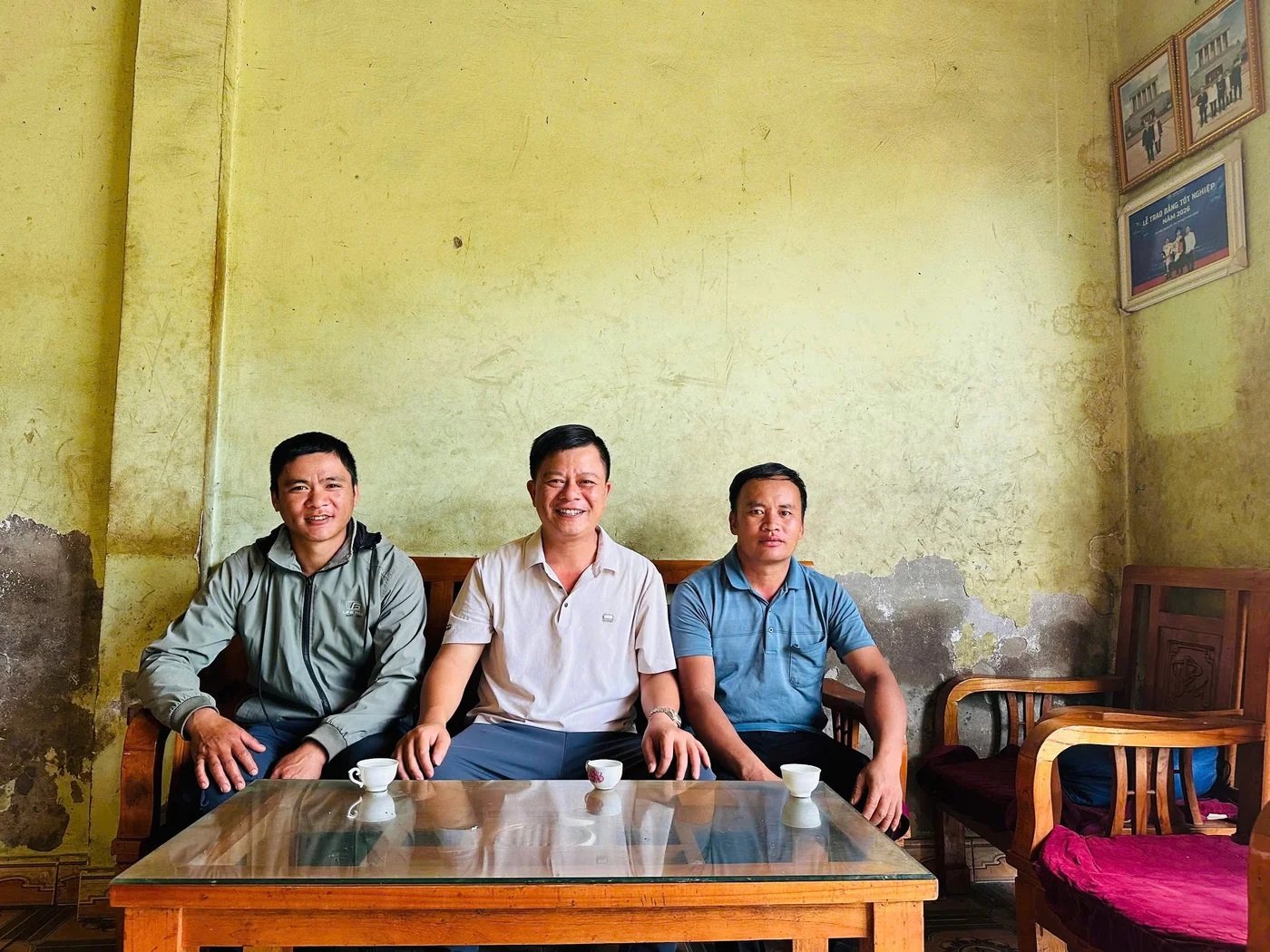
If Ngọc Tải was the calm, steady leader, A Goong was the talkative, cheerful spirit who could make any stretch of the trail fly by with his lighthearted stories. A Goong shared that he had spent two years serving as a border guard. Patrolling through old-growth forests and cloud-shrouded peaks had allowed him to understand his homeland in a different light. He didn’t just know the names of every stream, tree species, or forest trail; he understood exactly why they had to be protected. Beyond every forest lies the water source for the village; beyond every border lies the peace of the nation.
But Goong’s love for the mountains likely began even earlier. He told us that from the age of twelve, he had followed his elders into the woods to forage for medicinal plants. He remembered precisely which patch of forest held remedies for the kidneys or liver, which season boasted the most beautiful flowers, and where wild animals typically crossed. Perhaps it was from those formative experiences that a deep, abiding love for his homeland shone through every story he told about Putaleng.
As we walked, Goong turned and asked one of my friends, “Which village in Hanoi are you from?”
The entire group burst into laughter. Yet for Goong, it was a completely earnest question. In his world, Hanoi or Tả Lèng were simply places where people lived. That innocence somehow bridged the gap between the highlands and the plains, making them feel remarkably close. Goong was also among the first to scout and help open the Xin Chải–Putaleng trekking route. Most admirably, he belongs to a generation of young Dao who are choosing a new way of life: refusing to indiscriminately chop down trees, hunt wildlife, or overharvest medicinal plants, and instead bringing travelers into the forest so they can appreciate its true value.
Noticing how many photos we were taking, Goong smiled. “When I see you guys happy, when you praise the beauty of the mountains, I feel really tích too.”
That slightly mispronounced word for “happy” — tích instead of thích — was as unpretentious as the highland people themselves, yet it carried all the pride of a true son of the ancient wilderness.
A Tải, on the other hand, was entirely different. Quiet and solidly built like an ironwood tree, he was silent but worked harder than anyone else. While the rest of us were still taking photos or resting, A Tải would hoist the food supplies onto his back and push ahead to set up the kitchen, cook meals, boil water for our baths, and prepare the sleeping quarters.
By late afternoon, after hours of exploring the old-growth forests along the Xin Chải ridge, we reached our first shelter at an elevation of over 2,400 meters. The simple cabin was a wonderfully warm refuge for travelers who had just endured a grueling day of climbing. For the first-timers in our group, the physical demands of that initial ascent were a serious trial. We bathed and soaked our feet in hot water boiled with cardamom leaves; the soothing, fragrant steam drove away the highland chill and helped us recover our strength after the arduous trek.
Dinner in the heart of the forest was simple but rich in highland flavors. We had local pork marinated in fragrant wild màng tang [may chang, a mountain pepper] and grilled over the fire, stir-fried bamboo shoots, and a steaming bowl of wild vegetable soup. Even the cans of beer, chilled in the icy waters of the headwater stream, made everything taste better than usual. In a place that seemed completely removed from modern comforts, our porters managed to make us feel right at home.
Night fell with a biting cold. Inside the shelter, heavy logs were added to the fire. Exhausted, the five of us lacked the chatty energy we’d had at the start, and we soon crawled into our sleeping bags to rest for the grueling terrain ahead. Outside, the ancient wilderness remained awake, alive with the sound of rushing water and wind whispering through the ancient trees. Enveloped in the chill of Putaleng and the lingering scent of cardamom, we sank into a rare, profound sleep, as if the vast forest were quietly embracing the weary travelers after a long, hard day.
A Sea of Rhododendrons on the Roof of the Northwest
The next morning, while thin wisps of mist still clung to the ancient treetops around the camp, we resumed our trek toward the peak of Putaleng. The path from the first to the second camp wasn’t overly steep, but it wove relentlessly across ridges, deep ravines, and wild pristine forests. The early autumn sunlight pierced the old canopy, spilling onto the forest floor in shimmering streaks. Every so often, the cheerful chirping of birds echoed from a distance.
“They’re greeting our group,” A Goong said.
None of us knew if he was joking or serious, but in that crystal-clear morning air, we all wanted to believe it was true.
Around ten o’clock, Ngọc Tải stopped. He turned to the group and said, “We’ve reached the rhododendron forest, brothers.”
We walked a few dozen meters more, and everyone fell completely silent. Before us was a world that seemed to belong to a bygone era, predating paths, villages, or human footprints. Ancient rhododendrons stretched endlessly along the mountainsides. Some trunks were so massive that a grown man couldn’t wrap his arms around them, their bark a pale, moldy gray like ancient stone, their aged branches twisted and contorted by mountain winds and time. Yet, these gnarled canopies were bursting with vitality, laden with dark green leaves and tight clusters of buds waiting for the day they would finally bloom.
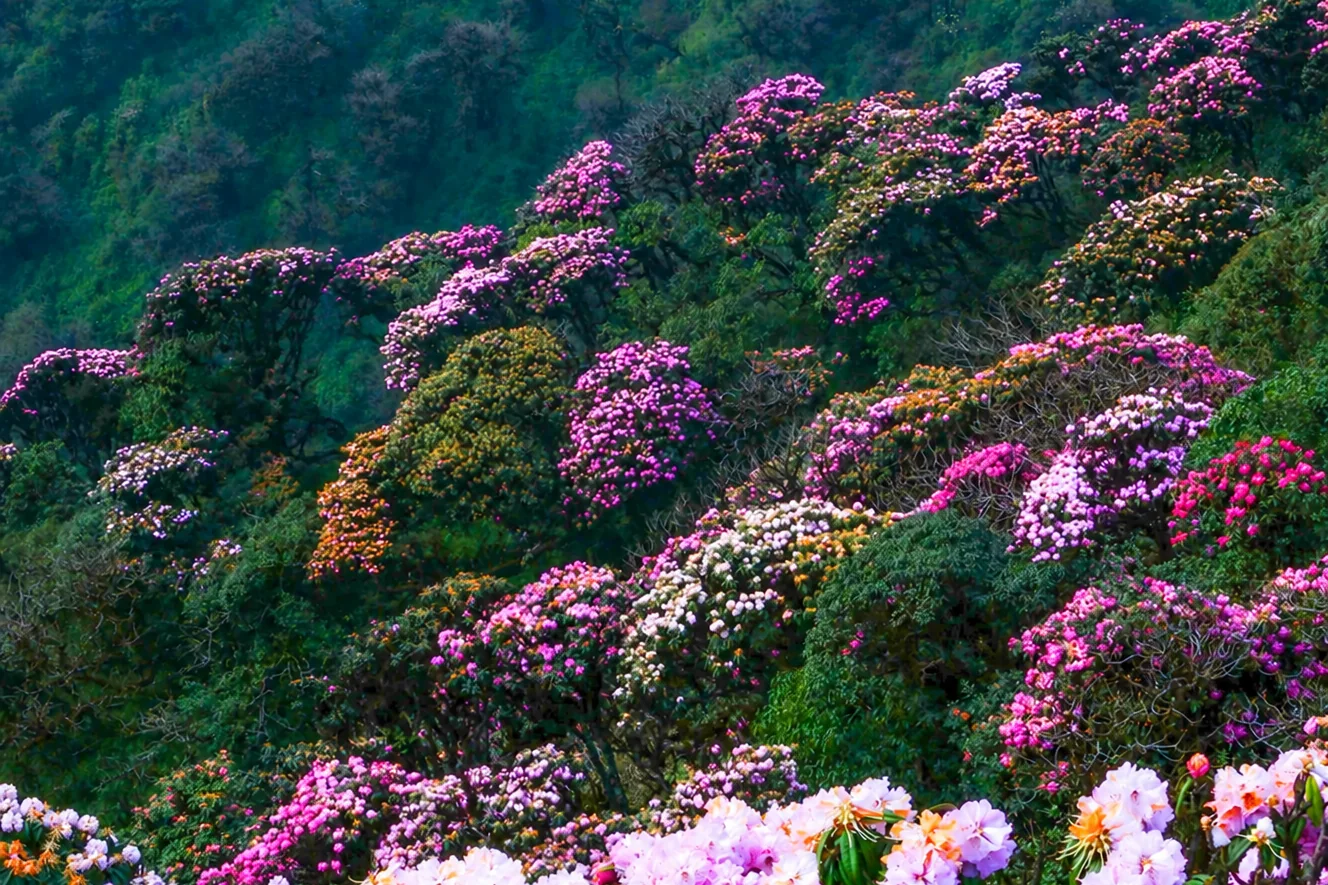
Ngọc Tải told us that in the spring, this entire forest transforms into a colossal sea of flowers. The blooms blanket the slopes and deep valleys in vibrant shades of red, pink, purple, and white. Clouds drift through the blossoming canopy like soft rivers. At that time of year, Putaleng is like a fairy tale.
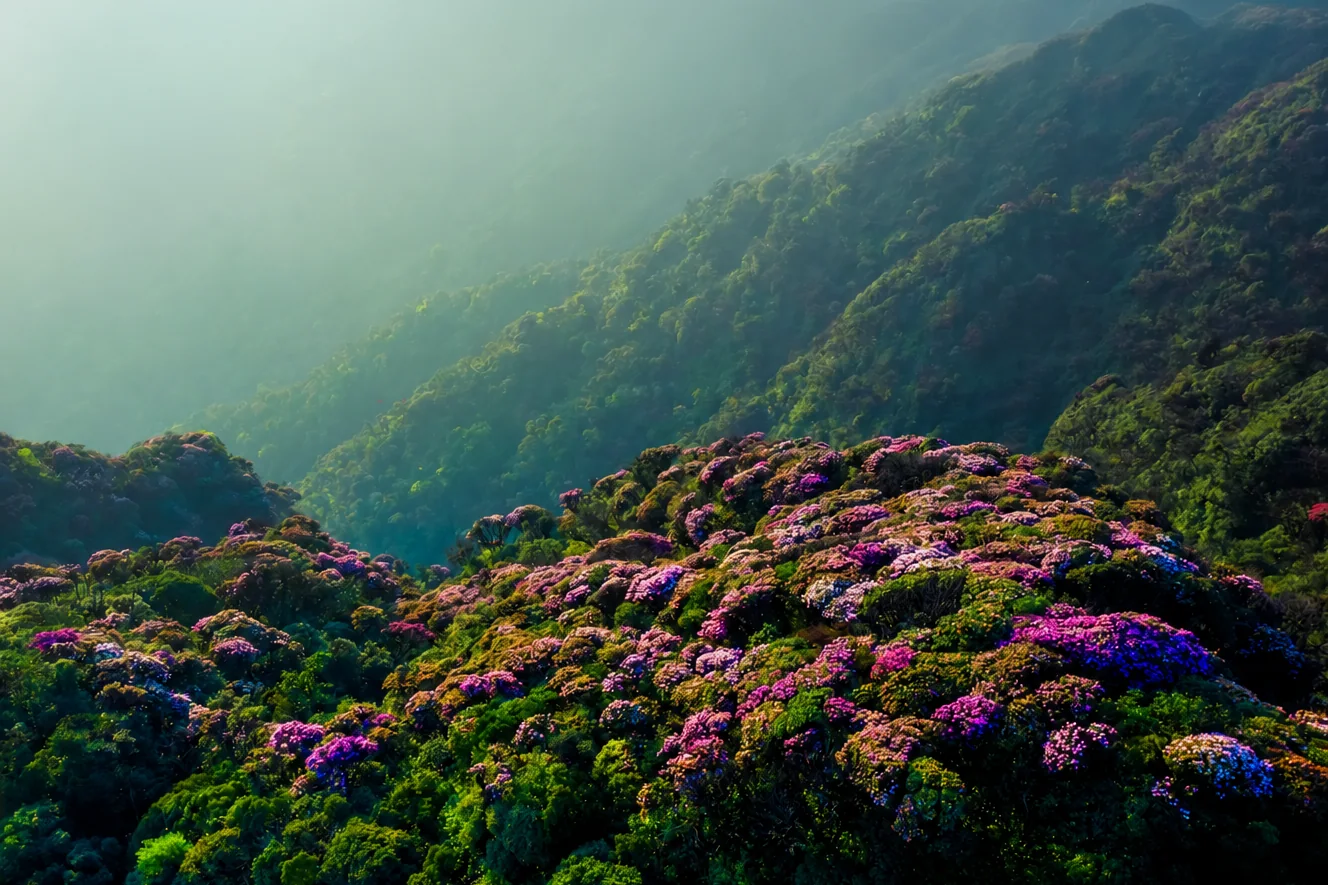
I looked at the ancient rhododendrons standing silently against the blue sky and tried to envision it. A sea of flowers stretching for kilometers at an altitude of over 2,500 meters. A sea of flowers nourished by the clouds of the Northwest, surviving across countless centuries. Perhaps nowhere else in Vietnam do rhododendrons grow in such abundance. This was not just a few groves; it was a botanical ocean expanding as far as the eye could see.
I had the distinct feeling that these rhododendrons had been standing there for a very long time, long before the first villages took root at the base of the mountain. They had quietly witnessed the clouds drift over Putaleng season after season. They had watched Dao and Hmong children grow up and slowly turn into silver-haired elders. They had seen generations come and go in the ancient wilderness. Beneath these lichen-draped sentinels, humans are merely passing guests in the endless flow of time. The vast mountain forest, with its pristine woods and immense sea of rhododendrons, is the true master of Putaleng.
If I could name this place, I would call it the “Valley of Love,” for in the culture of many highland ethnicities, the rhododendron is forever tied to tales of fidelity and steadfast waiting. These aged trees stand as silent witnesses to time. They remain there, guarding the mountain forest, keeping its legends alive, and quietly sheltering the dreams of the people.
We walked slowly through the woods, none of us wanting to leave so soon. At times, the trail along the ridge was barely half a meter wide, flanked by dense rhododendron shrubs that formed natural green walls. From a distance, parts of the ridgeline looked exactly like the spine of a giant dinosaur resting among the clouds.
Anyone who has ever climbed Putaleng would likely share the same sentiment: the mountains here are both majestic and deeply poetic. It is not a violent beauty that overwhelms the senses, but rather a beauty that compels you to stand still and gaze for a long time, to breathe deeply of the crisp air, and to listen closely to the wind weaving through the ancient branches.
That afternoon, after hours of climbing, the summit of Putaleng finally appeared. At the peak, the triangular metal landmark stood silently against the Northwest sky, beside the bright red national flag fluttering in the wind. Beneath the canopy of an ancient rhododendron, I felt the exhaustion of the journey instantly wash away. Before my eyes were endless layers of mountains rolling toward the horizon, while inside, I felt an incredibly peaceful sense of joy.
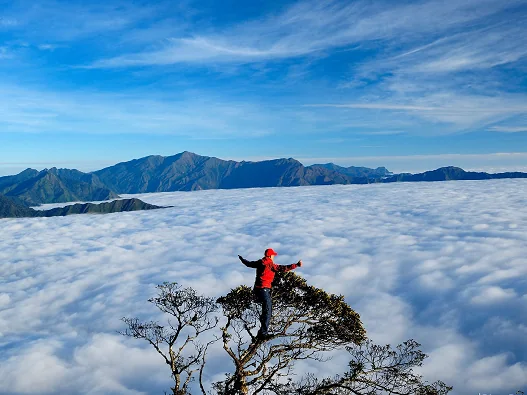
The mountain winds blew fiercely, dropping the temperature to about 6 degrees Celsius. Clouds continuously surged up from the valleys and swept over the peak. At times, standing in that sea of mist, I felt as if I were suspended between heaven and earth. Standing there at 3,049 meters, I finally understood why so many who visit Putaleng once inevitably return. They come back not just to conquer the peak again, but to rediscover a primordial sense of connection that has slowly been lost in the rhythm of modern life.
Stories by the Putaleng Fire
As the sun dipped completely behind the western ranges, darkness began to swell from the valleys. The headwater stream continued its tireless rush, and the wind slipped softly through the aged rhododendrons, carrying the damp scent of mossy stones and decaying leaves. The chirping of insects and calls of nocturnal birds evoked a remarkably strange, wild feeling.
After dinner, everyone gathered around the fire to chat, sipping green tea brewed from ancient tea leaves picked just that afternoon.
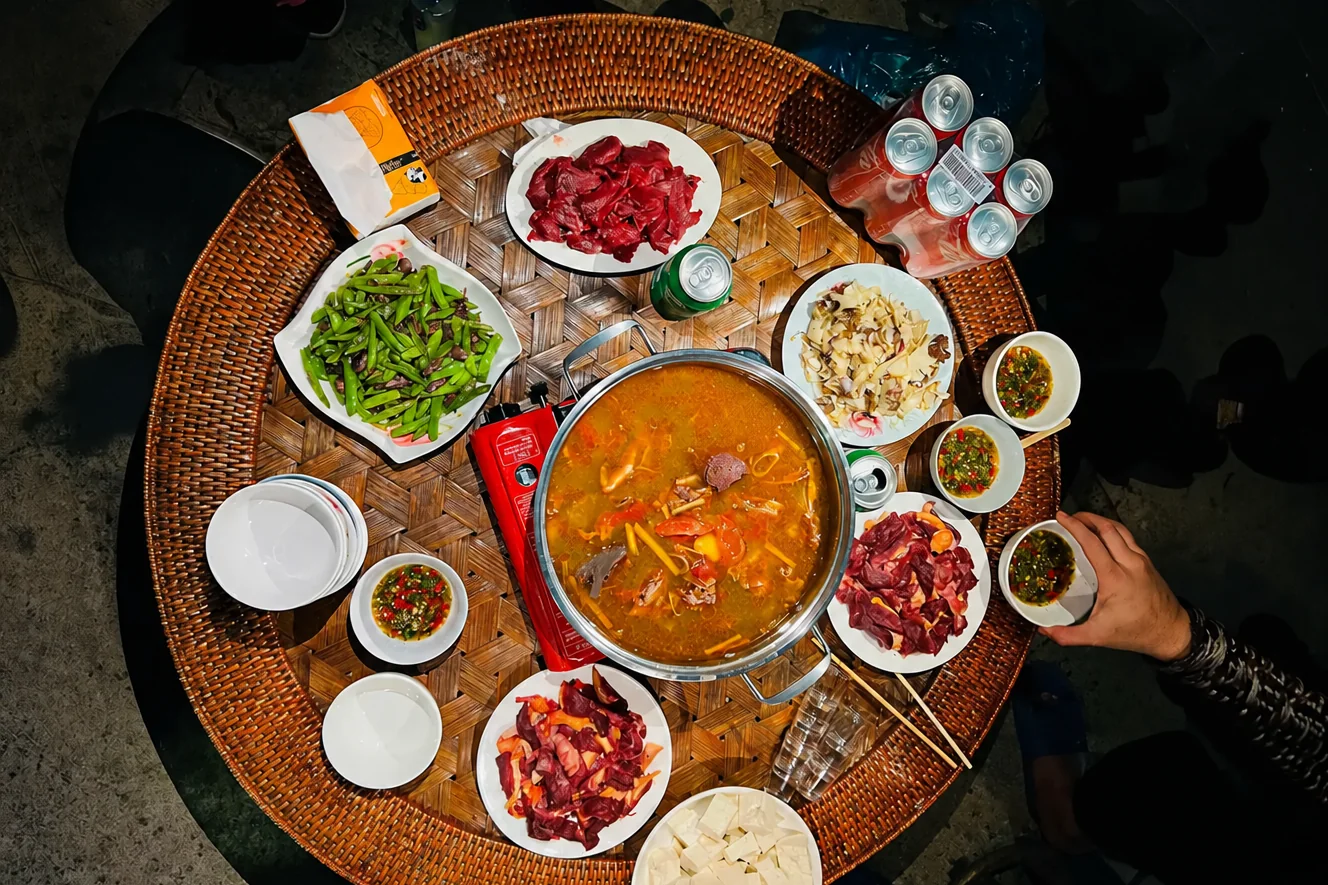
Feeding more firewood into the flames, A Goong remarked, “There are still bears up here, you know.”
Ngọc Tải gave a slight nod of confirmation. He shared that early in the spring, while clearing weeds along the trail to prepare for trekkers, he had spotted a large bear digging on the slope just two hundred meters away. Luckily, he was downwind that day, so the animal never noticed him.
Mention of the bear immediately drew A Tải into the conversation.
“We Dao people say that when a bear meets a human, it loves looking at our teeth.”
The group erupted in laughter, assuming he was joking. But A Tải remained deadpan.
“The elders say that long ago, a bear and a human had a tree-cutting contest. The bear used its teeth to gnaw, while the human used an axe. The bear was still struggling to chew through the trunk when the human’s tree came crashing down. Ever since then, bears have been obsessed with figuring out how insanely sharp human teeth must be to fell a tree faster than they can. So if one meets you, it just wants to have a look.”
The folktale had the whole cabin roaring with laughter. Yet, beneath the humor lay a vast repository of traditional knowledge passed down through generations in the Dao community. The highland people do not merely tell stories; they preserve an intimate understanding of the forest, its wildlife, and how to coexist with nature.
Then A Goong told us which parts of the forest held the most medicinal plants, and exactly which season and hour to harvest them for maximum potency. He knew which cliffs attracted wild honeybees, and the precise time to gather the thickest, most fragrant honey. Ngọc Tải, meanwhile, proved to be deeply knowledgeable about the legend of Bàn Vương, the ancestral figure of the Dao people, and traditional customs. It turned out that this young man was also a shaman trusted by the local community. He had the authority to preside over vital Dao ceremonies, such as the Lễ cấp sắc [coming-of-age initiation] and the traditional fire-jumping ceremony, Lễ nhảy lửa. Amidst the sprawling mountains, even as the rhythm of modern life creeps ever outward, young people like Tải are quietly safeguarding their ethnic heritage. I found this deeply moving, for culture does not merely exist in books. Culture lives in the people, in their relationship with nature, in the stories told by the hearth, and in the customs sustained across generations.
When the conversation turned back to the long-tailed macaques near the trekking route, Ngọc Tải’s eyes lit up. He spoke precisely about the size of the troop and recounted mornings spent watching them swing through the misty branches. He knew which male led the group, which females were nursing infants, and which season they most frequently appeared. Then he added:
“I hope that in the future, when guests come to the forest, they will see even more monkeys, not fewer.”
It was a simple sentiment, but it made me realize that to these young men, the forest was not just a resource. It was their livelihood, their culture, and their future. They may have never formally studied concepts like “eco-tourism” or “sustainable development,” but through their lived experience, they understood that if the forest vanishes, the water will disappear; if the wildlife dies out, the ancient wilderness loses its soul. If the rhododendrons cease to bloom on Putaleng, the travelers will stop coming.
In the flickering firelight of the Putaleng night, a deceptively simple truth dawned on me. The Dao people do not separate themselves from nature; they live within it, understand it, and honor it. Perhaps that is why their relationship with the forest is so profound — not the dynamic of an exploiter and a resource, but the bond between kin.
The hearth in the cabin burned bright red. Outside, the mountain wind continued to drive its biting chill through the mysterious old-growth forests.
The Golden Season at the Foot of Putaleng
On the third morning, Putaleng awoke in a delicate mist. The primary forest remained drenched in dew after the long night. From the shelter at over 2,500 meters, we began our descent toward Tả Lèng.
While the Giang Ma route leads trekkers through the ancient sea of rhododendrons, the path down to Tả Lèng offers a different kind of beauty. It is softer, more tranquil, and much closer to the rhythm of human life.
The trail hugged the headwater streams, accompanied by the gentle babbling of water the entire way. In some sections, the path wove through ancient Shan tea forests; in others, we had to balance on massive fallen logs crossing the streams like natural monkey bridges.
All the way down the mountain, A Goong regaled us with stories about the long-tailed macaques living on the rocky cliffs of Putaleng. He knew their feeding grounds and the exact crevices the mothers sought out to give birth. Once, while trekking, he had stumbled upon what the highlanders call huyết lình, a rare trace left behind after the macaques’ birthing season, prized in traditional folk medicine. What captured my attention was not the material value of his find, but rather the passionate way Goong detailed the monkeys’ habits — their breeding season, their foraging routes, and the specific crags they sheltered in during heavy rains. Listening to him, I realized that he didn’t just know the streams, trails, and forest patches of Putaleng; he intimately understood the quiet, pulsing life of the animals deep within the vast wilderness.
I asked him, “When more tourists start coming here, what is your greatest hope?”
Goong replied, “I only hope that when they come back a second time, the forest will still be exactly as it was the first time they saw it.”
That pure, rustic answer stayed with me for the rest of the descent.
At noon, we rested on a large flat rock beside the stream. A Tải swiftly cut broad wild banana leaves, folding them into makeshift bowls and pinning them together with young bamboo splinters. Within minutes, surrounded by the rush of the stream and the shade of the canopy, a humble feast was laid out in the heart of nature. It was one of the most memorable meals I have ever had.
After lunch, our group continued heading down the mountain. The dense forests gradually receded. Cardamom fields grew more frequent, followed by the faint outlines of Hmong rooftops peeking through the mountain greenery.
And then, suddenly, the golden season of Tả Lèng revealed itself.
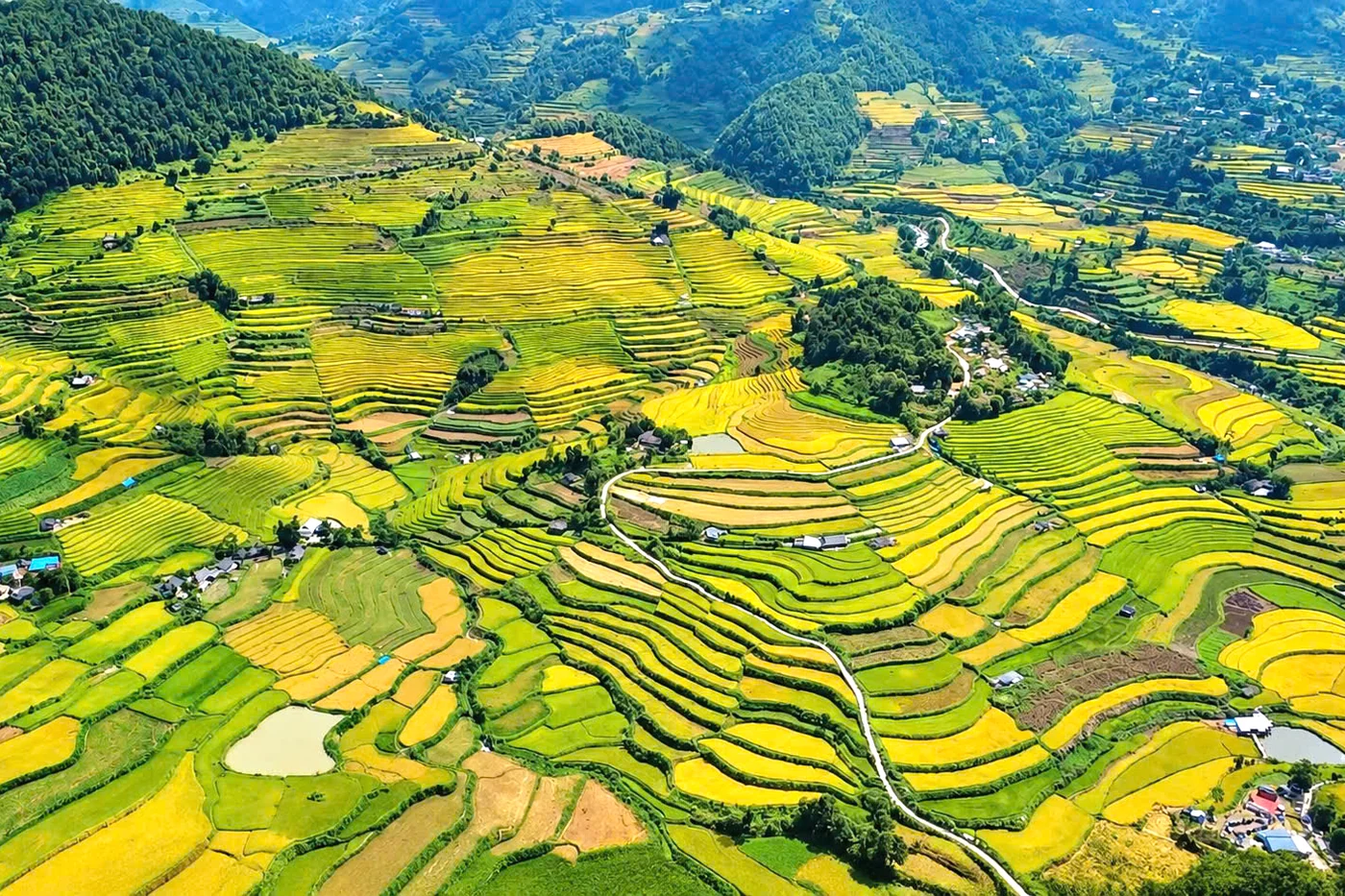
Looking down from above, the terraced rice fields curved sensuously around the mountain flanks, rolling in golden waves like colossal ribbons of silk draped artfully between heaven and earth.
It was the rice harvest season. The autumn sun glazed the terraces in a brilliant, luminous gold. Smoke from burning stubble drifted lazily up from freshly reaped paddies. The scent of newly harvested rice mingled in the wind with the aroma of straw, rich soil, and the unmistakable essence of the highlands. Together, they formed a tableau that was at once deeply serene and vividly alive.
My friends from Hanoi had traveled to the Philippines to see the magnificent Banaue Rice Terraces and strolled through the famous Tegalalang fields in Bali. Yet, standing before these terraced layers ascending into the heavens at Tả Lèng, they could not hide their awe. Perhaps it is because this place captivates not only with its scenic beauty, but with the boundless, untamed spirit of a land blessed by nature. These gleaming golden steps were built from the sweat, toil, and unwavering will to survive of countless generations of the Hmong people.
I suddenly realized that Putaleng and Tả Lèng were simply two sides of the same story. Over nearly thirty years of living and working in Lai Châu, I have traversed many villages, forests, and mountain peaks. But it wasn’t until this journey, suspended between Putaleng and Tả Lèng, that I felt the visceral connection between the forest, the water, and the people so clearly. Behind the golden harvest at the foot of the mountain are the pristine forests quietly holding water at the summit. And behind those ancient woods are the people who safeguard them day after day.
The Putaleng trek eventually came to an end. In the late afternoon, as our vehicle carried us away from Tả Lèng, the golden terraces gradually vanished behind winding mountain bends. Far in the distance, Putaleng still stood firmly amidst tiers of white clouds. In my mind’s eye, the gnarled rhododendrons, coated in moss and lichen, remained sharply in focus. They have weathered countless seasons of sun and rain, watched so many travelers come and go, and today, they had bidden farewell to yet another group of guests descending the mountain.
But the ancient wilderness remains, quietly standing guard over the blooming rhododendrons and the golden harvests at the foot of Putaleng.
Putaleng at a glance
| Height | 3,049 m — Vietnam’s 3rd-highest peak |
| Where | Tam Đường, Lai Châu (Hoàng Liên Sơn range) |
| Route in this essay | Up from Xin Chải (Giang Ma), down via Tả Lèng — 3 days |
| Difficulty | Hard — multi-day and steep; best with some trekking experience |
| Rhododendron bloom | March–April |
| Tả Lèng golden terraces | Around September |
Đinh Hồng Dương made this climb independently, with porters from Xin Chải village. If you’d like to walk the same mountain, Morning Vietnam runs guided Putaleng treks with local Dao hosts (from $103, 2-day trekking-only from Sa Pa). For how Putaleng compares with Vietnam’s other high peaks, see our guide to trekking Vietnam’s highest peaks; for more on the autumn gold, read rice harvest season in Sapa & the Northwest.
Guest essay by Senior Colonel Đinh Hồng Dương, a division head with the Lai Châu Provincial Police, published with the author’s permission. Translated from the Vietnamese by Morning Vietnam; we have kept as close to the original as possible. Photographs courtesy of the author and Morning Vietnam.